

🔴Developed by CDS Empore™
Empore™ E3Technology™
Single-Vessel Proteomics Sample Prep
Protein cleanup, detergent removal, and digestion — all in one column in minutes. Accessible to users of any expertise level, with a cost-effective workflow that eliminates multiple transfer steps.
⚡15-Minute Workflow
🛡 Single Vessel
✓ Detergent Removal

THE PROBLEM
Challenges in proteomics sample preparation
Costly
Current proteomics consumables are expensive, limiting adoption
High technical barrier
Current approaches require expert-level skills and extensive optimization.
Complex workflows
Easy-to-use, ready-to-go methods are needed but not available
THE SOLUTION
E-Series — a breakthrough platform for proteome science
E3Technology™ was engineered from the ground up to remove every friction point in proteomics sample preparation — from cost to complexity to reproducibility.
Efficient
Under 15 minutes hands-on time. Reproducible results every time.
Effective
Compatible with urea, SDS, RIPA, TFA, and GnHCl — any upstream lysis buffer.
Economical
Bridging the cost gap between genomics and proteomics consumables — no specialized equipment required.
Robust
Zero technical barrier — accessible to entry-level biomedical scientists, reliable in expert hands.
Versatile
Tips, filters, cartridges, and 96-well plates — covering all sample volumes and automation needs.
Stress-Free
No pH tuning, no protein-bead ratio, no cross-contamination — single-vessel workflow eliminates the pain points.
PROTOCOL
E3Technology™ Workflow in 7 Steps
Validated single-vessel protocol for protein digestion of cell lysate with E3filter — from precipitation to elution, all in one device. <15 minutes hands-on time (excluding overnight digestion).
1
Precipitation
Add 4× sample volume of 80% acetonitrile (or cold acetone / 90% methanol) to induce protein precipitation.
2
Sample Loading
Transfer the protein precipitate to the E3filter. Centrifuge at 2,000–4,000 rpm for 1–2 min and discard the flow-through.
3
Wash
Add 200 µL organic solvent, centrifuge, and discard flow-through. Repeat 2–3 times to remove detergents and salts.
4
Reduction & Alkylation
Add 50 mM TEAB + 10 mM TCEP + 40 mM CAA. Incubate at 45 °C for 5 min with gentle shaking.
5
Wash
Centrifuge to discard reagents, then add 100–500 µL 80% acetonitrile. Centrifuge again. Repeat 2–3 times to remove residual TCEP/CAA.
6
Digestion
Transfer device to a clean collection tube. Add 50 mM TEAB + Trypsin (or Trypsin/Lys-C, 1:50). Incubate at 37 °C for 16–18 hr.
7
Elution
Centrifuge to collect peptides. Re-elute with 50 mM TEAB and 50% ACN / 0.1% formic acid. Pool, dry, ready for LC-MS.
Loading capacity: E3tip ≤20 µg · E3filter 10–100 µg · E3cartridge 50–500 µg · E3plate 30–200 µg. Download full protocol PDF →
Performance Data
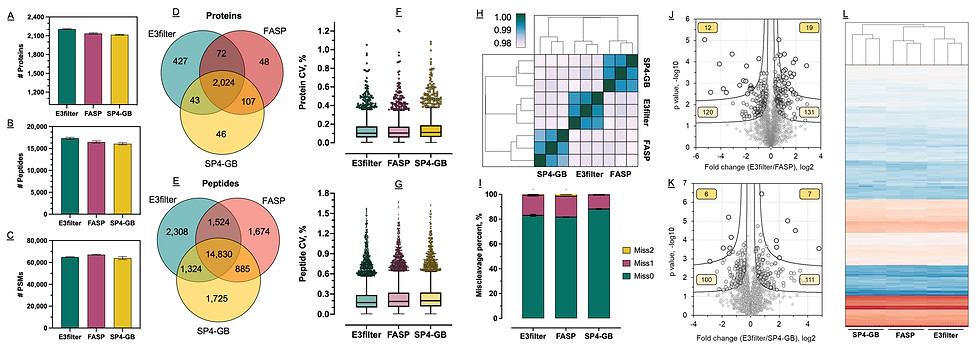
Validated Against S-Trap, FASP & Speed
Three independent benchmarks. Cells, tissues, leading alternatives.


Tissue-sample benchmark on mouse kidney against S-Trap, a popular spin-column proteomics workflow. E3tip and S-tip identified comparable counts of proteins, peptides, and PSMs (Panel A), with 3,464 proteins and 19,596 peptides shared between the two methods (Panels B–C). The global protein heatmap clustered E3tip and S-tip replicates tightly together, and quantitative scatter plots showed R² = 0.94–0.96, Pearson r = 0.97–0.98 across replicates — confirming E3 delivers equivalent results on tough tissue samples without S-Trap's SDS-dependent workflow.
Method-by-Method Comparison
Feature | E3Technology | S-Trap |
|---|---|---|
Hands-on time | < 15 min | ~ 30 min |
Lysis buffer | Flexible (urea/SDS/RIPA/TFA) | SDS required |
High-protein loading | No clogging | Filter clogging risk |
Recovery consistency | Robust across loads | Centrifugation-sensitive |
Low-input compatibility | Sub-µg validated | Limited |
Sample types | Cells, tissues, fluids | Cells, tissues |
Cost per sample | Low | Medium-high |
E-Series
E3Technology or E4Technology?
Both belong to the Empore™ E-Series single-vessel platform. Choose based on your starting material.
E3Technology™
Start from protein lysate
-
For cells that are already lysed (urea, SDS, RIPA, TFA)
-
General bottom-up proteomics workflows
-
Sub-µg to mg range — extremely flexible
-
5 formats: E3tip, E3filter, E3cartridge, E3plate
-
FASP replacement in under 15 minutes
E4Technology™
Processes intact cells directly
-
Skip cell lysis and protein extraction steps
-
Low-input and single-cell proteomics optimized
-
100–1,000 cells up to 50M cells (format-dependent)
-
7 formats including E4tip Ultra for single cells
-
Deeper proteome profiling from intact material
PRODUCTS
E-Series product catalog
Popular configurations. Full catalog available in our shop.
Product | Technology | Format | Size | Capacity | Qty |
|---|---|---|---|---|---|
E3Tip™ | E3 | Pipette Tips | 10 µL | General | 25/96 |
E3tip™ | E3 | Pipette Tips | 200 µL | General | 25/96 |
E3filter™ | E3 | Spin Column | 500 µL | General | 25/100 |
E3plate™ | E3 | 96-Well Plate | 1.2 mL | General | 1/12 |
E3cartridge™ | E3 | Cartridge | 3 mL | General | 50/150 |
E4tip™ | E4 | Pipette Tips | 10 µL | 100–1K cells | 25/96 |
E4tip™ | E4 | Pipette Tips | 200 µL | 1K–10K cells | 25/96 |
E4tip™ XL | E4 | Pipette Tips | 200 µL | 10K–50K cells | 25/96 |
E4filter™ | E4 | Spin Column | 500 µL | 50K–5M cells | 25/100 |
E4cartridge™ | E4 | Cartridge | 3 mL | 50K–5M cells | 50/150 |
E4plate™ | E4 | 96-Well Plate | 1.2 mL | 50K–5M cells | 1/12 |
E2 Gel-Crusher | E2 | Gel-Crusher | -- | -- | 25/100 |
RESOURCES
Resources for E3Technology™
Download technical documents and application notes
279 Applying Empore™ E3technology™ to Proteomic Sample Preparation
FAQ