


EPA Method 8141B: Determination of Organophosphorus Pesticides in Ground Water Using the Empore™ SDB-RPS SPE Disk
Authors: Xiaohui Zhang, Guotao Lu
Study summary: CDS Empore™ SDB-RPS Solid Phase Extraction disks facilitate rapid and reliable sample preparation and provide excellent analyte recovery for hydrophilic compounds with clean chromatograms. A validated EPA Method 8141B workflow extracts organophosphorus (OP) pesticides from 1 L ground water samples spiked at 5.0 ppb using a 47 mm SDB-RPS disk, with GC/MS quantification. Across the 24 compounds listed in EPA Method 8141B, average recovery was 89.6% with 3.3% averaged RSD — compared with 82.3% recovery and 6.4% RSD in the EPA 8141B guideline data. 23 of the 24 compounds fell within the 70%–130% range required by the method.
TL;DR: OP pesticides are hard to extract for two reasons — the method calls for a full litre of sample, and the compounds themselves readily hydrolyse and oxidise, which can cause coelution in GC analysis. Running 1 L ground water through a 47 mm Empore™ SDB-RPS disk and eluting with acetone and MTBE gave 89.6% average recovery across the 24 EPA 8141B compounds at 3.3% RSD, from only three runs. 16 of the 24 recovered better than the EPA guideline values. The single compound below 70% was Dimethoate at 67.2%.
Study at a Glance
Introduction
OP pesticides are the most widely used pesticides in the world to control agricultural, household and structural pests. They are favoured because they do not persist in the environment for prolonged periods, and because they do not accumulate in the body fat of humans and other animals thanks to their ready hydrolysis.
That same property, however, is sometimes misleading to the public and can decrease awareness of the hazards these compounds present. Without sufficient precautions, people can be routinely exposed through several routes: consumption of fresh and processed vegetables, direct contact with pesticide-contaminated surfaces, breathing air near pesticide application, and drinking contaminated water.
Why the regulatory attention: On the toxicology side, the primary mechanism of OP pesticides is inhibition of the enzyme acetylcholinesterase, mainly targeting the central nervous system, respiratory tract and cardiovascular system. To raise public awareness and increase public safety, EPA classifies most OP pesticides as either toxicity class I (highly toxic) or toxicity class II (moderately toxic), and regulates these compounds through mandatory EPA methods.
How EPA 3535A and EPA 8141B Fit Together
EPA Method 3535A includes OP pesticides as target compounds to be cleaned and concentrated by SPE using Empore™ SDB-RPS disks. EPA Method 8141B then defines the quantification of OP contaminants from ground water samples by GC/MS instrument. In short, 3535A governs the sample preparation and 8141B governs the determinative step.
A few major challenges arise on the sample preparation side of these methods:
Large sample volume — a full 1 litre per extraction
Unstable chemical structure — OP pesticides readily hydrolyse and oxidise, which can result in coelution during GC analysis
In this application note, a one-litre water sample was passed through a 47 mm SDB-RPS Empore™ disk and eluted with acetone and methyl tert-butyl ether (MTBE) under negative pressure. The solvent was then exchanged to hexane, and the extract was dried and reduced in volume to 1.0 mL for GC/MS analysis. The validation data presented here was determined from three runs of SDB-RPS disks from the same lot.
Headline result:
Average recovery across 24 compounds: 89.6%, averaged RSD 3.3%
EPA 8141B guideline values for the same 24 compounds: 82.3% recovery, 6.4% RSD
16 of 24 compounds recovered better than the EPA guideline value
23 of 24 compounds fell within the required 70%–130% range
Only compound below 70%: Dimethoate at 67.2%
Experiment Setup
SPE Media
Chemicals
8140/41 analytes (26 compounds) — Restek (Bellefonte, PA)
Sodium sulfite — Sigma-Aldrich (St. Louis, MO)
Water, acetone, hexane, MTBE, methanol — all high purity pesticide quality, Burdick & Jackson (Muskegon, MI)
Sample Pre-treatment
40 mg of sodium sulfite was added to 1 L of purified water (Millipore Milli-Q™ system) to reduce free chlorine. 5 mL of methanol was added to the water sample as a wetting agent. Each sample was fortified with 5 µg of each internal standard. For recovery data, each sample was additionally fortified with 5 µg of each method analyte, giving a spike level of 5.0 µg/L (5.0 ppb).
GC/MS Configuration
Instruments: Shimadzu GC-2010 Gas Chromatograph with a split/splitless injection portal, interfaced to a Shimadzu GC-MS QP2010 (Kyoto, Japan), with a 30 m × 0.25 mm ID GsBP-5MS column, 0.25 micron film (General Separation Technologies, Newark, DE).
GC Parameters
Oven Temperature Program
Mass Spectrometer Parameters
Validated EPA Method 8141B SPE Procedure
Assemble an all-glass filtration assembly using a 47 mm SDB-RPS Empore™ disk. Use of a manifold for multiple extractions is acceptable.
Wash the extraction apparatus and disk by adding 5 mL of acetone to the reservoir. Pull a small amount through the disk with a vacuum; turn off the vacuum and allow the disk to soak for about one minute. Pull the remaining solvent through the disk and allow the disk to dry. Add 5 mL of methanol as the second washing step, and repeat the previous washing steps one more time.
Condition the disk by adding approximately 5 mL of methanol to the reservoir, pulling a small amount through the disk, then letting it soak for about one minute. Pull most of the remaining methanol through the disk, leaving 3 to 5 mm of methanol on the surface of the disk.
Add 20 mL of reagent water to the disk and, using the vacuum, pull most through — again leaving 2 to 3 mm of water on the surface of the disk.
Add the water sample to the reservoir and, under vacuum, filter as quickly as the vacuum will allow. Drain as much water from the sample bottle as possible. Dry for three minutes under vacuum.
Remove the filter assembly and insert a suitable sample tube for eluate collection.
Add 0.6 mL of acetone to the disk and soak for one minute.
Add 5 mL of MTBE to the sample bottle. Rinse the bottle thoroughly and transfer the solvent to the disk with a disposable pipette, rinsing the sides of the filtration reservoir in the process.
Pull half of the solvent through the disk, then release the vacuum. Allow the remaining solvent to soak the disk for about one minute, then draw the remainder through under vacuum.
Repeat the solvent rinse of the sample bottle and apparatus using 5 mL of MTBE twice more.
Using a disposable pipette, rinse down the sides of the filtration glassware with two 3 mL aliquots of MTBE.
Dry the combined eluant with 10 grams of granular anhydrous sodium sulfate. Rinse the collection tube and sodium sulfate with two 3 mL portions of MTBE and place the combined solvent into a concentrator tube. The solvent is exchanged to hexane.
Concentrate the extract to 1 mL under a gentle stream of nitrogen (may be warmed gently).
Critical concentration note: Do not concentrate to less than 0.5 mL — loss of analytes could occur.
Results and Discussion
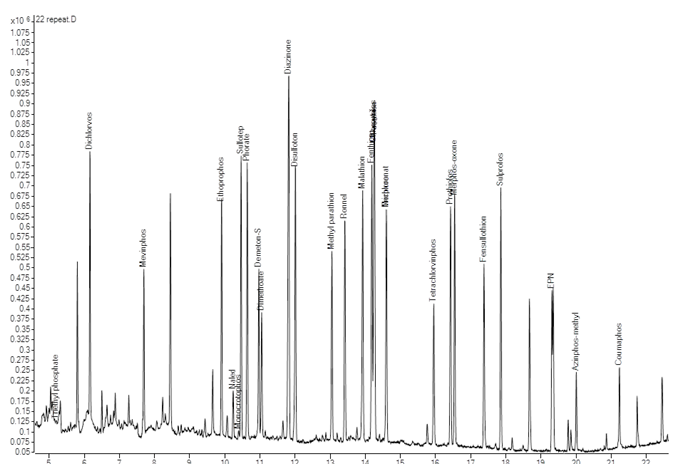
Figure 1 shows the GC chromatogram of the 26 OP pesticide compounds in the 8140/41 analytes standard. Of these 26 compounds, only 24 are on the EPA Method 8141B list. The chromatogram shows that these compounds were well separated under the experimental conditions used.
Overall Recovery Performance
Performance across the 24 EPA 8141B compounds:
This method — average recovery 89.6%, averaged RSD 3.3% (n = 3, 5.0 µg/L)
EPA 8141B guideline — average recovery 82.3%, averaged RSD 6.4% (n = 7, 10.0 µg/L)
16 of the 24 compounds had better recovery rates than the EPA 8141B guideline values
23 of 24 compounds fell within the 70%–130% range, passing EPA Method 8141B
Comparison caveat: The two data sets in Table 1 were generated under different conditions. The current validation used a 5.0 µg/L spike over three runs, while the EPA 8141B guideline values are from a 10.0 µg/L spike over seven runs. The comparison is therefore indicative of relative performance rather than a matched head-to-head study.
Table 1 — Average Recovery and RSD Comparisons for Compounds in EPA 8141B
The One Compound Below 70%: Dimethoate
The only compound with recovery less than 70% was Dimethoate, whose recovery rate was calculated as 67.2%. According to the study, this recovery rate could be improved by minimizing hydrolysis and oxidation through different optimized experimental conditions — which was not the focus of this application.
Consistency: 3.3% RSD from Three Runs
The 3.3% averaged RSD from only three runs shows great consistency in the performance of Empore™ SDB-RPS disks, which makes redundant runs aimed at improving RSDs unnecessary. For laboratories running ground water monitoring at volume, this directly reduces the number of extractions needed per batch to demonstrate acceptable precision.
Conclusion
A simple and effective method to extract organophosphorus pesticide compounds from a large volume 1 L water sample using Empore™ SDB-RPS 47 mm disks has been validated per EPA Method 8141B. 24 OP pesticide compounds listed in the method were separated from water samples and quantified by GC-MS at a concentration of 5.0 ppb:
23 of these 24 compounds had recoveries in the range of 70%–130%, which exceeds the requirement in EPA Method 8141B
The average recovery rate was higher than the EPA 8141B guidelines, at a much lower 3.3% RSD
In summary, excellent analyte recovery and clean chromatograms could be obtained with Empore™ SDB-RPS disks. The data supports the claim that CDS Empore™ SDB-RPS disks are well qualified for screening ground water samples according to EPA Method 8141B for monitoring OP pesticides.
Frequently Asked Questions
What is EPA Method 8141B?
EPA Method 8141B defines the quantification of organophosphorus contaminants from ground water samples by GC/MS. It is part of Test Methods for Evaluating Solid Waste, Physical/Chemical Methods. EPA classifies most OP pesticides as either toxicity class I (highly toxic) or toxicity class II (moderately toxic) and regulates these compounds through mandatory EPA methods.
How does EPA Method 3535A relate to EPA Method 8141B?
EPA Method 3535A is the solid phase extraction method, and it includes OP pesticides as target compounds to be cleaned and concentrated by SPE using Empore™ SDB-RPS disks. EPA Method 8141B then defines the quantification of those OP contaminants from ground water by GC/MS. In practice, 3535A covers the sample preparation step and 8141B covers the determinative step.
What recovery does the Empore SDB-RPS disk achieve under EPA Method 8141B?
Across the 24 compounds listed in EPA Method 8141B, average recovery was 89.6% with an averaged RSD of 3.3% at a 5.0 ppb spike level over three runs. For comparison, the EPA 8141B guideline values for the same 24 compounds average 82.3% recovery with 6.4% averaged RSD. 23 of the 24 compounds fell within the 70%–130% range required by the method.
What are the main sample preparation challenges in EPA Method 8141B?
There are two. First, the large sample volume of one litre. Second, the unstable chemical structure of OP pesticides, which readily hydrolyse and oxidise and can result in coelution during GC analysis. Empore™ SDB-RPS disks are used to address both challenges in this workflow.
Why did Dimethoate show recovery below 70%?
Dimethoate was the only compound of the 24 with recovery under 70%, calculated at 67.2%. According to the application note, this recovery rate could be improved by minimizing hydrolysis and oxidation through different optimized experimental conditions, which was outside the focus of this application.
Why is sodium sulfite added to the water sample?
40 mg of sodium sulfite is added to the 1 L water sample to reduce free chlorine. 5 mL of methanol is then added to the water sample as a wetting agent before extraction.
Which Empore SDB-RPS disk part number is used for EPA Method 8141B?
The CDS Empore™ 47 mm SDB-RPS disk, Part # 2241 — also available as Fisher Scientific 13-110-022 and VWR 76133-140 — from CDS Analytical, Oxford, PA. One disk is used per 1 L extraction in an all-glass filtration assembly.
How many replicates are needed to get reliable data from SDB-RPS disks?
This validation used three runs from the same lot of disks and achieved an averaged RSD of 3.3% across 24 compounds. The application note concludes that this level of consistency from only three runs makes redundant runs aimed at improving RSDs unnecessary.
References
EPA Method 3535A: Solid-Phase Extraction (SPE), part of Test Methods for Evaluating Solid Waste, Physical/Chemical Methods.
EPA Method 8141B: Organophosphorus Compounds by Gas Chromatography, part of Test Methods for Evaluating Solid Waste, Physical/Chemical Methods.


Comments