


EPA Method 8270E: Extract 125 Semi-Volatile Organic Compounds from Water Using the Empore™ 8270 Disk
Updated: May 1
Authors: Xiaohui Zhang, Guotao Lu, Michael Apsokardu
A validated EPA Method 8270E workflow using the CDS Empore™ 8270 Disk extracts 125 semi-volatile organic compounds (SVOCs) from 250 mL water samples spiked at 20 µg/L. Most compounds achieved recovery greater than 75% with RSD below 15% (n=3), making the workflow a versatile, regulator-compliant option for wastewater detection laboratories operating under EPA 8270E and SW-846 Method 3535.
Study at a Glance
Introduction: The Challenge of Quantifying SVOCs in Water
Semi-volatile organic compounds (SVOCs) are a chemically diverse class of pollutants that pose well-documented risks to human health and the environment. Their tendency to adsorb onto surfaces, combined with their presence in everyday products — cleaning agents, personal care products, electrical components, pesticides, water, and food — makes accurate measurement difficult for environmental laboratories. Documented health effects include allergenic responses as well as reproductive and endocrine disruption, depending on the compound and exposure level.
EPA Method 8270E is the standard regulatory method used worldwide to quantify SVOCs in water, soil, and leachate samples. The full method covers 243 compounds, but most laboratories routinely analyze a subset of 100+ compounds spanning these classes:
Polynuclear aromatic hydrocarbons (PAHs)
Chlorinated hydrocarbons and pesticides
Phthalate esters
Organophosphate esters
Nitrosamines
Haloethers, aldehydes, ethers, ketones
Anilines, pyridines, quinolines
Aromatic nitro compounds
Phenols
Solid-phase extraction (SPE) is explicitly recognized in EPA Method 8270 as a suitable sample preparation alternative, and the companion EPA Method 3535 outlines general SPE procedures. This application note documents how the CDS Analytical Empore™ 8270 Disk has been validated to extract 125 SVOCs from water in compliance with EPA Method 8270E.
Key findings at a glance:
Most of 125 tested SVOCs: recovery > 75%
Most compounds: RSD < 15% (n=3)
Single composite-disk workflow with easy reverse elution
Shorter drying time compared to loose-packed cartridge SPE
Validated for 250 mL water samples at 20 ppb spike level
Why Use the Empore™ 8270 Disk for EPA Method 8270E?
The Empore 8270 Disk applies particle-loaded PTFE membrane technology to the SVOC workflow, delivering several practical advantages over loose-packed sorbent formats:
Easy to stack and apply — the membrane format allows the 8270 disk to be stacked with activated carbon disks in a single composite assembly
Easy reverse elution — the disk can be inverted for elution, simplifying recovery of target analytes
Relatively shorter drying time compared with traditional cartridge SPE
Quantitative extraction across a wide compound range — most of the 125 tested compounds achieve recovery > 75% with RSD < 15%
This makes the Empore 8270 Disk a versatile option for wastewater detection laboratories that need to satisfy the broad analyte list of EPA 8270E in a single workflow.
Materials
Reference Standards
All reference materials were purchased from Restek:
Ammonia methanol solution (Catalog #499145) was purchased from Sigma-Aldrich.
Critical note on PDS preparation: Per EPA Method 8270 recommendations, when preparing primary dilution standards (PDS), keep nitrosamines in a separate vial, and do not mix amines with aldehydes.
SPE Media (per single extraction)
One Empore™ 8270 Disk — SKU 98-0604-0246-0
Two Empore™ Activated Carbon Disks — SKU 98-0604-0235-5
SPE Equipment
CDS Empore™ EZ-Trace SPE Workstation — SKU 98-0604-0801-7
GC/MS Configuration
Instrument: Shimadzu GCMS-QP2010
GC Conditions
Oven Temperature Program
MS Conditions
Validated EPA 8270E SPE Procedure
1. Sample Preparation
Take a 250 mL water sample. Add 0.4 mL of concentrated hydrochloric acid and shake thoroughly so the pH is below 2.0. Add 20 mg of thiosulfate and shake thoroughly. Spike the 8270 standards PDS into the water sample at 20 µg/L, shake thoroughly, and set aside.
2. SPE Media Setup (Composite Disk)
Place an Empore 47 mm 8270 disk on top of two layers of Empore 47 mm activated carbon disks to form a composite disk — 8270 disk on top, two activated carbon disks on the bottom. Mount the composite disk into the EZ-Trace, equipped with a vacuum pump.
3. Conditioning
Condition the composite disk in this sequence:
Load 5 mL DCM. Apply vacuum to pass 1/3 of the DCM volume through the disk to a waste bottle. Stop the vacuum and allow the disk to soak in DCM for 1 minute. Drain the remaining DCM.
Load 5 mL methanol. Apply vacuum to draw most of the methanol through the disk, leaving a thin layer of methanol on the disk surface.
Load 10 mL reagent water. Apply vacuum until a thin layer of water remains on the disk.
Load 10 mL of 0.05 N hydrochloric acid aqueous solution. Apply vacuum until a thin layer of acidic water remains on the disk.
4. Sample Loading
Load the 250 mL spiked water sample onto the disk. Control the vacuum to maintain a flow rate of 15–20 mL/min. Before sample loading is complete, rinse the original sample bottle with 10 mL of 0.05 N HCl solution and load the rinse onto the disk.
5. Drying
After the water sample has fully drained, dry the disk under high vacuum (e.g., −25 inHg) for 10 minutes.
Critical drying note: Dry for a well-controlled period. Eluting a wet disk may cause back-extraction of some acidic compounds. Conversely, do not over-dry the disk, as some sensitive compounds may oxidize.
6. Elution
Invert the composite disk so that the activated carbon side faces up and the 8270 side faces down.
Elution Part 1 — Acidic and Neutral Analytes
Wash the inner side of the sample bottle with 5 mL of methanol/DCM (5/95) solution and load it onto the disk.
Apply vacuum to pass 1/3 of the solvent volume through the disk into Collection Vial A.
Soak the disk for 1 minute, then collect the remaining eluate dropwise into Collection Vial A.
Repeat the previous step.
Dry the eluate from Vial A through 10 g of anhydrous sodium sulfate, collecting the dried eluate into a concentration vial. Rinse the sodium sulfate with 3 mL DCM and combine into the concentration vial.
If the target analytes do not include phenolic species, the sodium sulfate drying step may be skipped.
Elution Part 2 — Basification and Elution of Basic Analytes
Switch to Collection Vial B for the next portion of eluate. (If phenolic species are not target analytes, this vial-replacement step can be omitted, and the eluate combined into Collection Vial A.)
Wash the sample bottle with 5 mL of 95/5 DCM/0.35 N methanolic ammonia and load it onto the disk. Apply vacuum to pass 1/3 of the solvent volume into Collection Vial B. Soak for 1 minute, then collect the remaining eluate dropwise into Collection Vial B.
Load 5 mL of methanol/DCM (5/95) onto the disk. Apply vacuum to pass 1/3 of the solvent through into Collection Vial B. Soak for 1 minute, then collect the rest dropwise into Collection Vial B.
Dry the eluate in Vial B through the same sodium sulfate drying column used in Part 1, and combine with the dried eluate from Part 1. Rinse the sodium sulfate with 2 × 3 mL DCM and combine.
7. Concentration
Gently reduce the volume of the dried eluate at 45 °C under nitrogen blowing to less than 1 mL (no less than 0.5 mL). Cap or seal the concentration cup so that only a narrow opening is left to vent nitrogen and organic vapor. After adding the internal standard, bring the final volume to 1.0 mL with DCM.
Results and Discussion
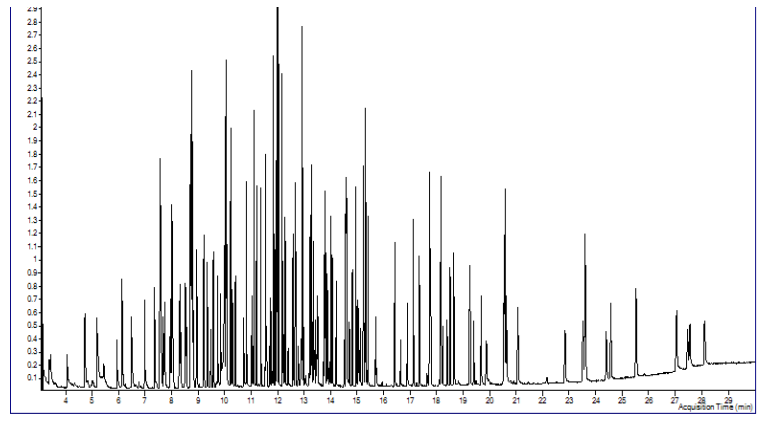
The full GC/MS chromatogram of the selected EPA 8270 compounds is shown in Figure 1, and the recovery data for all 125 compounds is shown in Table 1.
Overall Performance
With this relatively simple SPE workflow, most compounds achieve recovery greater than 75%, and the RSD for most compounds is below 15%. This level of reproducibility, combined with the broad analyte coverage, makes the method suitable for routine wastewater monitoring under EPA 8270E.
Key insight: The composite disk format (8270 disk + 2 activated carbon disks) combined with reverse elution delivers quantitative recovery across a chemically diverse 125-compound set in a workflow simpler than equivalent loose-packed cartridge SPE.
Compound-Specific Observations
Phentermine (α,α-Dimethylphenethylamine) showed chromatographic problems after extraction — peak shape deformation and retention time shifts — which made quantification difficult.
Benzidine is a known problem compound due to probable oxidative loss during concentration. The concentrator used in this experiment minimized sample loss by avoiding contact between oxygen and the sample solution. However, oxidative loss associated with the disk drying process was still observed to some extent. The three benzidine-class compounds (Benzidine, 3,3'-Dimethylbenzidine, 3,3'-Dichlorobenzidine) were therefore tested in separate experiments to avoid likely reactions with other compounds.
Table 1 — Recovery Data for 125 SVOCs
Conclusion
This application note documents a validated EPA 8270E workflow built on the CDS Empore™ 8270 Disk, taking full advantage of membrane-based solid-phase extraction technology — easy stacking, easy reverse elution, and shorter drying times. The method delivers quantitative recovery across a broad range of SVOCs, with most compounds achieving recovery above 75% and RSD below 15%. For wastewater laboratories that need a reliable, regulator-compliant SPE option for the EPA 8270E analyte list, the Empore 8270 Disk offers a versatile, defensible solution.
Frequently Asked Questions
What is EPA Method 8270E used for?
EPA Method 8270E is the U.S. EPA's standard method for determining the concentration of semi-volatile organic compounds (SVOCs) in liquid, solid, and leachate samples. The full method covers 243 compounds, but most laboratories analyze a subset of 100+ compounds spanning PAHs, chlorinated hydrocarbons, pesticides, phthalate esters, organophosphate esters, nitrosamines, haloethers, aldehydes, ketones, anilines, pyridines, quinolines, aromatic nitro compounds, and phenols.
Is solid-phase extraction (SPE) acceptable for EPA 8270E sample preparation?
Yes. Solid-phase extraction is described as a suitable sample preparation alternative within EPA Method 8270, and the companion method EPA 3535 outlines the general use of SPE for SVOC extraction. The Empore 8270 Disk has been validated to extract 125 SVOC compounds from water in compliance with EPA Method 8270E standards.
What recovery and reproducibility does the Empore 8270 Disk achieve for EPA 8270E?
In a validated 250 mL water sample workflow at a 20 ppb spike level (n=3), most of the 125 tested SVOCs achieved recovery greater than 75% with RSD below 15%. This level of reproducibility makes the workflow suitable for routine wastewater monitoring under EPA 8270E.
Why is an activated carbon disk used together with the Empore 8270 Disk?
The validated EPA 8270E workflow uses a composite disk: one Empore 8270 Disk on top of two Empore Activated Carbon Disks. The 8270 disk handles primary SVOC retention, while the activated carbon disks support recovery of compounds during reverse-direction elution. This composite stacking is one of the key advantages of membrane-format SPE — disks can be combined easily, and the disk can be inverted for elution.
What product SKUs are needed for EPA 8270E with Empore disks?
A single extraction requires:
One Empore 8270 Disk (47 mm) — SKU 98-0604-0246-0
Two Empore Activated Carbon Disks (47 mm) — SKU 98-0604-0235-5
The recommended SPE manifold is the CDS Empore EZ-Trace SPE Workstation — SKU 98-0604-0801-7.
Why do benzidine compounds need to be tested separately in EPA 8270E?
Benzidine, 3,3'-Dimethylbenzidine, and 3,3'-Dichlorobenzidine are subject to probable oxidative loss, particularly during sample concentration and disk drying. To avoid likely reactions with other compounds in the analyte mix, these three benzidine-class compounds were tested in separate experiments. Minimizing oxygen contact during concentration and avoiding over-drying of the disk are recommended practices.
What sample volume and spike level were used to validate the Empore 8270 Disk?
The validation used 250 mL water samples spiked at 20 µg/L (20 ppb) with EPA 8270 standard mixtures. The samples were acidified to pH below 2.0 with concentrated hydrochloric acid before extraction. All recovery measurements are based on n=3 replicates.
Is the Empore 8270 Disk compatible with other EPA methods?
The Empore disk family is referenced in 18+ official EPA methods, including 525.2, 525.3, 527, 1613B, 1664, and 8270E. The 8270 Disk specifically targets the broad SVOC analyte list of EPA 8270E and SW-846 method 3535. For other applications such as PFAS, dioxins, or pesticides, dedicated Empore disk chemistries are available (SDB-XC, C18, Oil & Grease).
Where can I purchase the Empore 8270 Disk?
The Empore 8270 Disk is manufactured by CDS Analytical at our facility in Oxford, Pennsylvania, USA. Contact us at info@cdsanalytical.com or visit our Empore Disk product page to request a sample or quote.
Related resources: Empore Disks | EZ-Trace Workstation
References
U.S. Environmental Protection Agency. SW-846 Test Method 8270E: Semivolatile Organic Compounds by Gas Chromatography/Mass Spectrometry (GC/MS). Revision E.
U.S. Environmental Protection Agency. SW-846 Test Method 3535: Solid-Phase Extraction (SPE).


Comments